
VISITBALLATER
Walking

Cambus O May
The Cambus o’ May woods (Site of Special Scientific Interest (SSSI)) start about 2.5 miles east of Ballater. The woods have a couple of large ponds and there are some superb views of Lochnagar. There are several attractive forest walks, three of which are waymarked. A longer walk leads through the woods to the Burn o’ Vat in the Muir of Dinnet Nature Reserve. It is possible to walk to Cambus O’May direct from Ballater.

Deeside Way
The Deeside Way is a 67 km (42 mile) long distance path that follows, in part, the bed of the former Deeside Railway, running from near the centre of Aberdeen, oil capital of Europe, to Ballater, in the Cairngorms National Park. The path is suitable for walkers and cyclists with many sections suitable for horses as well and is Route 195 of the National Cycle Network.

Craigendarroch Hill
Ballater sits at the foot of Craigendarroch Hill – Craigdendarroch may be a small hill, but it has a big place in the affections of Ballater folk. Its oakwood-clad flanks are steep making its ascent an enjoyable but arduous little walk. The views are superb! Craigendarroch means ‘Hill of Oaks’. This wonderful hill contains some beautiful short walks giving fine views across the village. There are also wonderful views of the Dee valley and Lochnagar. In autumn the contrasting colours of the oaks, pine and birch make it especially appealing. The wood contains much wildlife and information boards within the wood help to provide a better understanding to the visitor.
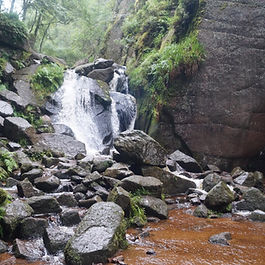
Burn O' Vat
Burn o’ Vat is an example of a pothole, located close to Loch Kinord, near the village of Dinnet in Aberdeenshire, Scotland. Around 16 000 years ago, the area surrounding Burn o’ Vat was covered by a glacial ice sheet. As the area warmed around 14 000 years ago, the ice sheet began to melt, resulting in a torrent of meltwater that carried with it debris previously caught up in the glacial ice. It is thought that a rock became lodged in a small hollow on the river bed, causing the meltwater to flow around it in a spiralling motion. This spiralling motion caused the bed underneath the rock to erode over a long period of time. Around 13 500 years ago the volume of meltwater decreased to such a level that the stream began to deposit more than it was eroding. This change resulted in the deposition of sand and gravel into the bottom of the pothole. It is believed that this sediment extends down around 5–7 metres, below the current ground level, though no-one can be certain of the true value. Approximately 12 000 years ago, the entrance to the vat was exposed when the rock in front of it was undercut by the same stream that formed the vat, albeit in the form of a waterfall. The pothole, known locally as ‘The Vat’, measures 18 metres across and 13 metres high, from present ground level.
Burn O'Vat, an amazing bowl-shaped geological feature which was carved out by glacial melt at the end of the last Ice Age. The walk is situated in the Muir of Dinnet National Nature Reserve which has many more trail options.
Muir of Dinnet
Walkable from Ballater, the Muir of Dinnet is one of 8 National Nature Reserves in the Cairngorms National Park. It includes Loch Kinord and Loch Davan as well as the famous Burn o’ Vat (or to some MacGregor’s Cave) – a very large barrel measuring 18 metres across and 13 metres high formed by melting ice 14,000 years ago! The Visitor Centre at the Burn o’ Vat is open daily and as a guide there is a network of 4 paths to explore the Reserve. The reserve extends 1163 hectares, from the River Dee to Culbean hill, encompassing a wide range of habitats. The Reserve was first declared in 1977 because of its value as a habitat for flora and fauna, and important geomorphological features. Muir of Dinnet NNR is owned by Dinnet Estate and managed by Scottish Natural Heritage (SNH), who provide a visitor centre and a range of other facilities on the Reserve.
Loch Muick
Loch Muick is an upland, freshwater loch lying approximately 9 miles south of Ballater, Scotland at the head of Glen Muick and within the boundary of the Balmoral estate. Glas-allt Shiel, the hunting lodge originally built for Queen Victoria and completed in 1868,lies at the western end of the north shore of the loch. A good path leads all the way around Loch Muick and taking the low level route this is about 8 miles long.
Tullich Kirkyard
A nationally important Scheduled Monument to the east of Ballater – has been undergoing a sensitive repair and consolidation led by Aberdeenshire Council with support from the North East Preservation Trust (NESPT). The works have been made possible thanks to funding from Aberdeenshire Council, Cairngorm LEADER, Heritage Lottery Fund, Wolfson Foundation and Historic Environment Scotland without whom the project would not be possible.